
DESIGN PARTNERSHIPS
Better design starts with better decisions.
Healthcare projects often depend on decisions that must be resolved before design can perform at its best.
Amplara Advisors helps executives, clinicians, operators, and design teams clarify those decisions, align around what the project needs to accomplish, and translate them into a stronger foundation for planning and design.
A force multiplier for sophisticated healthcare design teams.
The objective is not to add another workstream. It is to remove ambiguity from the work already underway.
Where we strengthen the team
BEFORE THE PURSUIT
Create clarity around the challenge the client actually needs to solve.
Strong pursuits show more than capability. They demonstrate that the team understands the problem. Amplara Advisors helps design teams examine the client's strategic context, identify the decisions and tensions shaping the opportunity, and frame the questions that will matter to executive leadership.


PLANNING + PRE-DESIGN
Resolve the decisions the design depends on.
Projects can move into programming before the organization has fully resolved the assumptions underneath them. Amplara Advisors works with executives, clinicians, operators, and designers to clarify the care model, demand, operations, workforce, experience priorities, constraints, and trade-offs that should shape the project.
The goal is not to take planning away from the architect. It is to give the architect better decisions to design from.
AS DESIGN DEVELOPS
Keep clinical reality, operational performance, and design intent connected.
As design evolves, Amplara Advisors helps test how the environment will support care delivery, workflow, staffing, throughput, technology, patient experience, and staff experience. We bring clinical and operational perspective to the table, challenge assumptions, identify opportunities for improvement, and help stakeholders understand how design choices affect the way care will actually work.
The question is not only whether the design reflects the original intent. It is whether the design helps the organization perform better.

FROM ORGANIZATIONAL INTENT TO DESIGN DIRECTION
The Design Brief
Broad goals rarely translate directly into design decisions.
Amplara Advisors brings the critical planning inputs into a shared Design Brief that gives executives, clinicians, operators, planners, and designers one place to understand what is informing the design
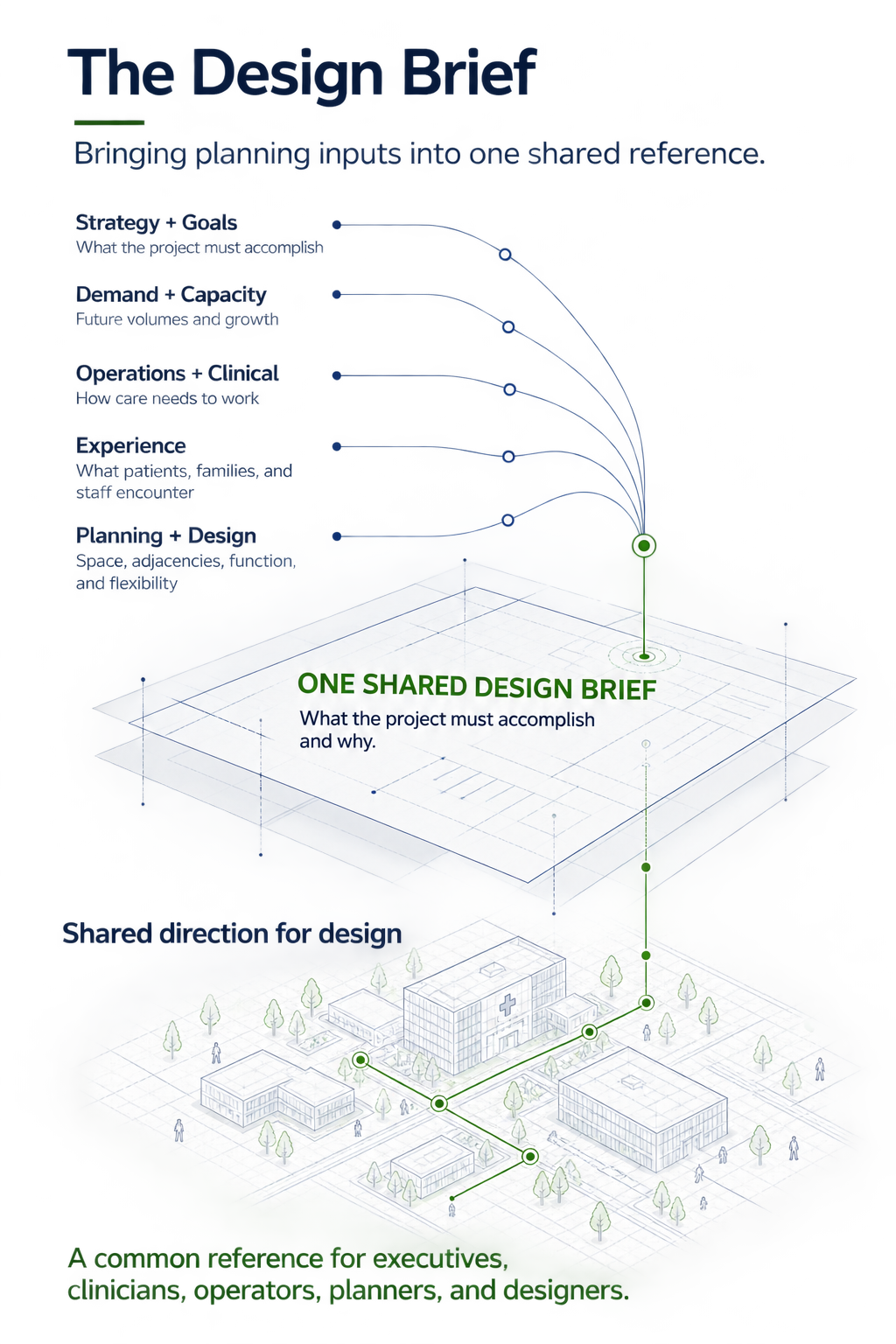
One shared reference for what the project must accomplish and why.
The difference shows up in the outcome
Confidential Community Health System | Southeastern U.S.
The system knew it needed to grow. It had not yet decided what the new campus needed to become.
A regional health system was responding to explosive, diffuse growth across a market whose communities had very different needs.
Patients increasingly wanted care closer to home, while many physicians remained resistant to leaving the primary downtown campus. An existing freestanding emergency department and imaging center provided a foothold in the growth market, but leadership still needed to determine what the campus should ultimately become, which services belonged there, how much capacity would be required, and how the campus should evolve over time.


The master plan established the basis for design.
Before a design team was selected, the planning work defined the role of the campus within the health system, established market and demand assumptions, identified future services and capacity, and translated projected volumes into program and space requirements.
What must this campus make possible, now and as the market changes?
The advisory role did not end when design began.
Once the design team was selected, Amplara Advisors worked with the client to overlay the master plan with operational flows, patient and employee experience expectations, future care models, emerging technologies, and the long-term vision for campus evolution.
Throughout design, that perspective helped the team test how clinical and operational intent should influence decisions such as adjacencies, expansion capacity, future service additions, and the ability of the campus to evolve as care delivery changed.
The result was continuity from strategy through design.
The planning assumptions that justified the investment did not disappear when architecture began. They remained part of the design conversation, helping the client and design team connect today's building decisions to tomorrow's operating model, service portfolio, and campus growth.

A BETTER PARTNERSHIP MODEL
The architect leads design. Amplara Advisors strengthens the decisions that shape it.
For the design team, that can mean stronger pursuits, clearer direction, better executive conversations, fewer reversals, stronger alignment, and a design better equipped to perform as intended.